

Key Takeaways
- The debate over short-form vs. long-form content is officially outdated; in the AI search era, you absolutely need both, but for entirely different reasons.
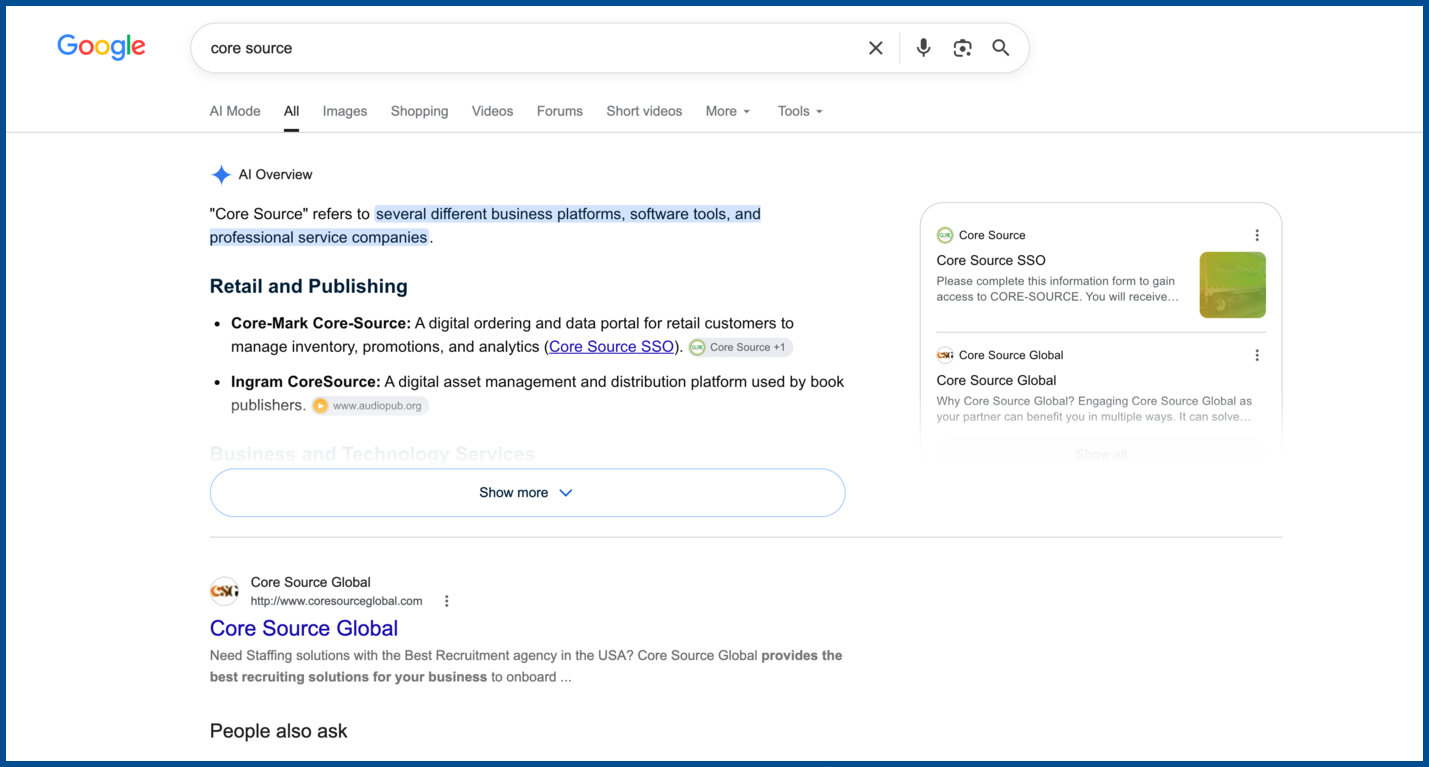
- Large Language Models (LLMs) and Google’s AI Overviews crave deep, authoritative information. Long-form content provides the “core source” data these engines need to cite you.
- Short-form content is no longer just for quick entertainment. It is the engine of algorithmic social discovery, designed to capture attention and feed the top of your marketing funnel.
- Pitting the two against each other is a mistake. Modern brands use short-form to get discovered and long-form to build the deep semantic trust that AI search engines demand.
- Building this dual-threat content strategy takes time, but services like SERPninja.io can help you build the high-authority, long-form assets that AI search engines love to cite.
The world of search engine optimization (SEO) is going through a massive identity crisis.
For years, marketers have obsessed over the exact length a blog post should be. But then, AI stepped onto the scene. With the rise of tools like ChatGPT and Google’s new AI Overviews, the way people find information on the internet has fundamentally changed.
Suddenly, search engines aren’t just looking for a list of keywords. They are reading, summarizing, and generating direct answers in real-time.
Because of this massive shift, business owners are asking a critical question: When it comes to short-form vs. long-form content, what actually works anymore? Do people still read 2,000-word guides, or should we all just be making 15-second vertical videos?
The reality is that your beautiful, snappy videos and your deeply researched blog posts are no longer competing with each other. They are playing two entirely different sports.
Let’s break down exactly how AI search engines process information today, and how you can stop choosing between content lengths and start building a modern, highly profitable search funnel.
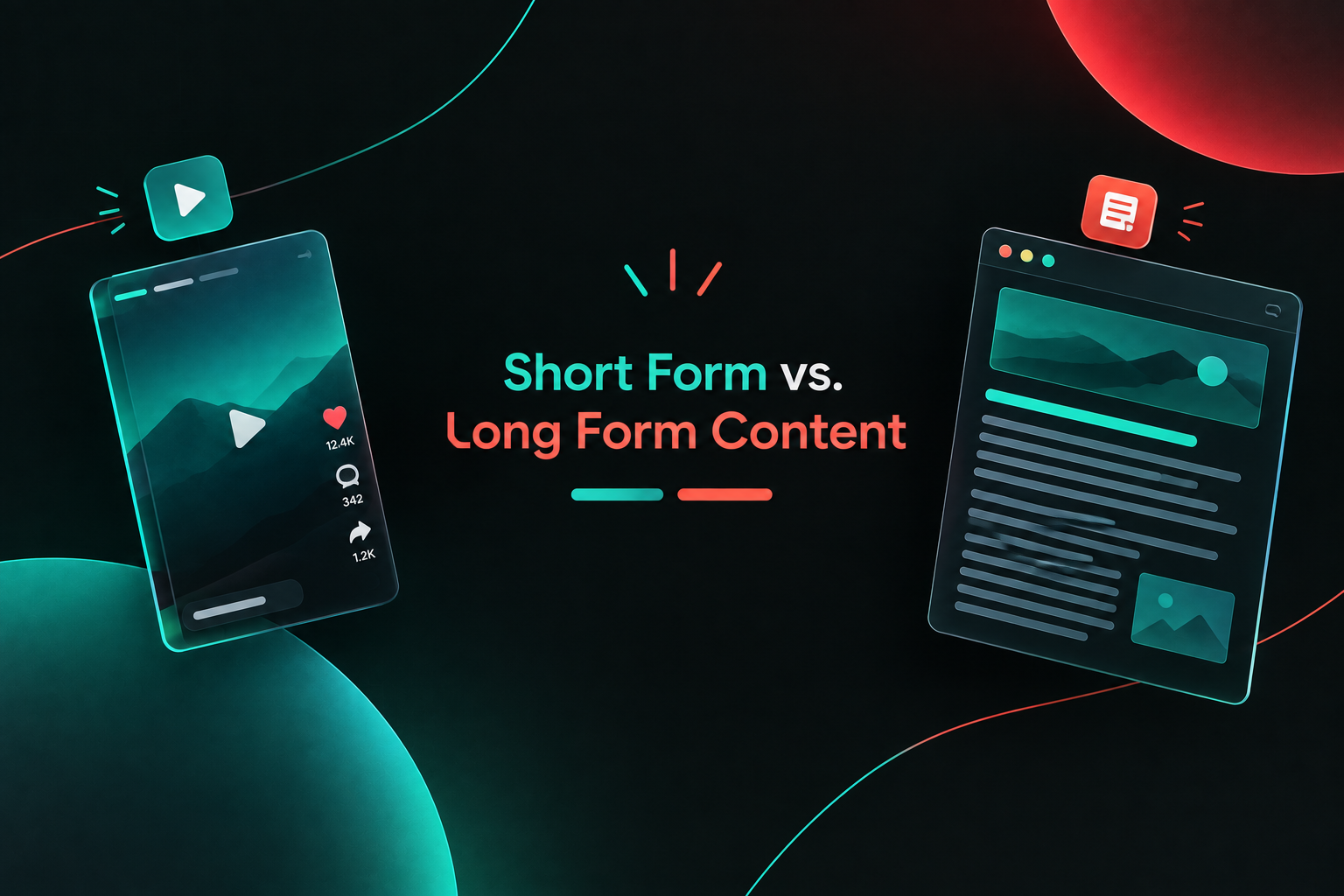
Short Form vs. Long Form Content: What Actually Ranks in the AI Search Era?

To understand what ranks today, you have to understand how modern AI search actually works.
In the old days, Google acted like a librarian. You typed in a query, and it handed you a list of 10 blue links that contained your keywords.
Today, Google’s AI acts like an expert researcher. It doesn’t just hand you a list of links. It reads dozens of pages, synthesizes the facts, and writes a custom summary right at the top of your screen.
So, how do the different content formats fit into this new, forward-looking landscape? Let’s break it down:
- Long-Form Content Builds “Entities”: AI engines look for deep, semantic connections. A 2,000-word article allows you to cover a topic from every angle. This proves to the AI that you are a comprehensive “core source” of truth.
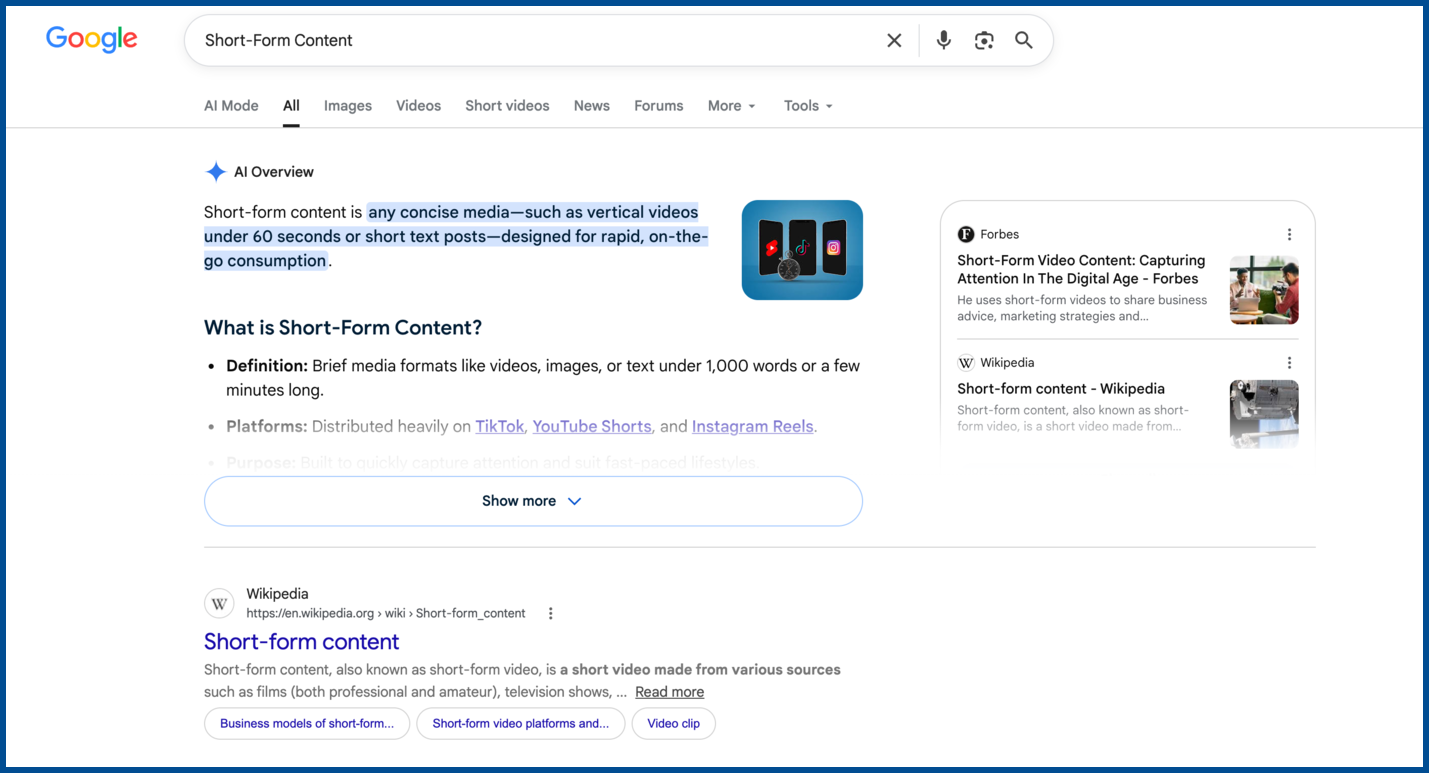
- Short-Form Content Drives “Discovery”: AI Overviews rarely cite 15-second videos to explain complex topics. Instead, short-form thrives on platforms like TikTok, YouTube Shorts, and Instagram Reels to trigger algorithms that put your face in front of thousands of new people instantly.
- The Citation Factor: When an AI tool like ChatGPT or Google AI Overviews formulates an answer, it needs to cite a reliable source. Long-form content provides the data, statistics, and depth required to earn that highly coveted citation link.
- The Attention Factor: Human attention spans are shrinking. Short-form content acts as the hook that stops the scroll, while long-form content is the destination where they actually learn to trust your brand.
In short: Long-form content builds your authority with the robots. Short-form content builds your awareness with the humans.
Why You Need Long-Form to Be the “Core Source” (And How SERPninja Can Help)
Let’s dive a little deeper into the long-form side of the equation.
Imagine you run a cybersecurity company. You want to rank for the search term “how to prevent small business phishing attacks.”
If you just write a 300-word blog post that says, “Don’t click bad links, use a strong password, and buy our software,” an AI search engine is going to ignore you entirely. Why? Because that post lacks depth. It lacks data. It lacks context.
Large Language Models (LLMs) are essentially giant prediction engines. They need context to understand how valuable your website is. When you write a comprehensive, 2,500-word guide that covers the history of phishing, current statistics, real-world examples of breaches, and a step-by-step prevention framework, you give the AI a goldmine of data.
You become what is known as a “core source.” When the AI writes a summary for a user, it pulls directly from your deep well of information and places a link to your website right at the top of the search results.
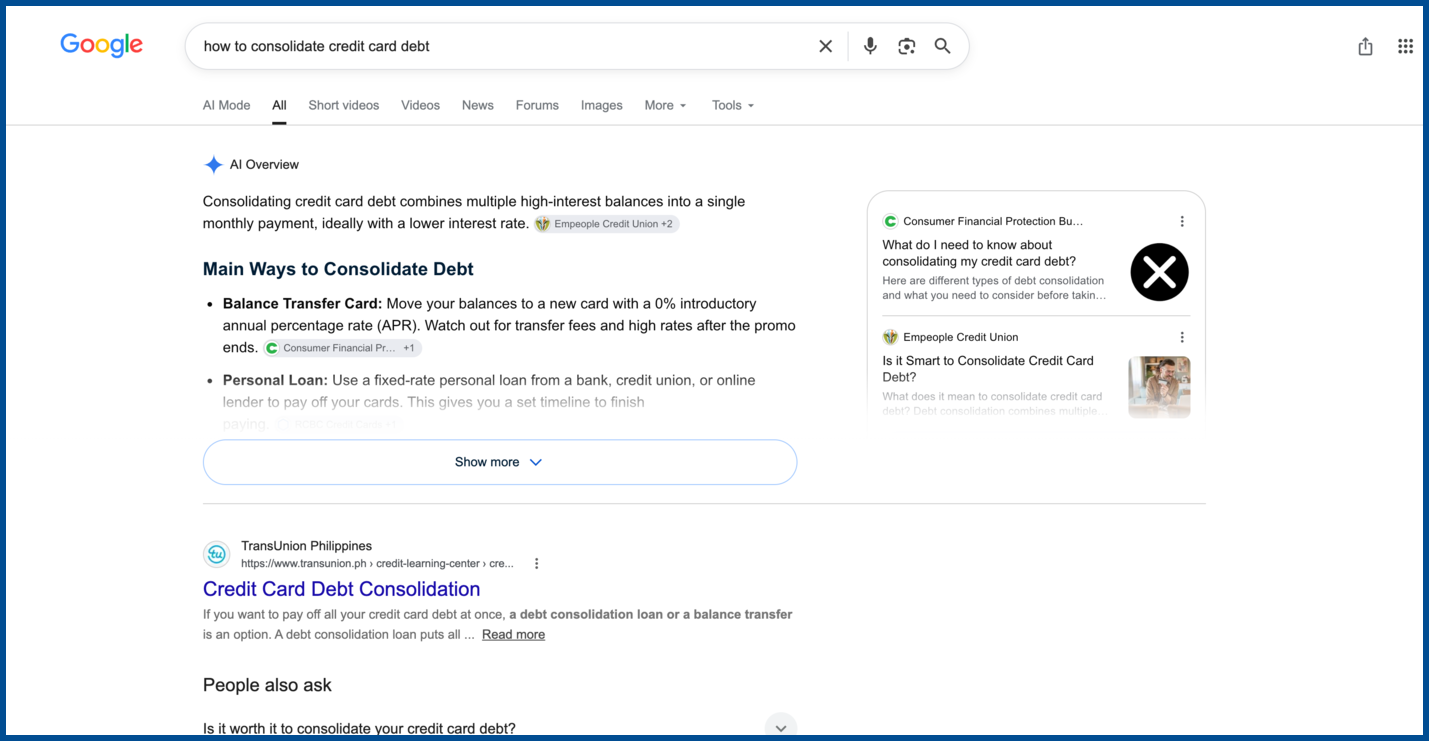
Let’s look at a real-world example. Think about a popular financial blog like NerdWallet. When you ask Google’s AI “how to consolidate credit card debt,” it doesn’t cite a funny Instagram Reel. It cites NerdWallet’s massive, 3,000-word guide, because the AI recognizes it as the most complete, factual source on the internet.
Of course, writing these massive, heavily researched articles takes an incredible amount of time and effort. As a founder or marketer, you probably don’t have 15 hours a week to write blog posts.
That is exactly where SERPninja comes in.
If you want to dominate AI search results, you need high-quality, authoritative content at scale. SERPninja.io provides expert-led content creation and link-building services that signal to search engines that your website is the ultimate authority in your niche. They build the long-form assets that AI engines crave, allowing you to focus on running your actual business.
The Hidden Power of Short-Form Content for Algorithmic Discovery
If long-form content is so important for AI search, should we just abandon short-form completely? Absolutely not.
While long-form content answers the questions people are already asking, short-form content introduces people to questions they didn’t even know they had.
This is called algorithmic discovery.
Platforms like TikTok, YouTube Shorts, and Instagram Reels have revolutionized how content is distributed. In the past, you needed a massive following to get a lot of views. Today, the algorithm serves content based on user interest, not follower count.
This means a brand new account can post a 30-second video and reach a million people overnight.
Let’s use a real-world example. Imagine a local fitness coach.
- She writes a brilliant, 2,000-word long-form guide on her website about “macro-tracking for beginners.” The AI search engines love it, and it slowly brings in steady, highly targeted traffic.
- But then, she takes out her phone and films a quick, 15-second video showing a common mistake people make when measuring peanut butter.
- The algorithm pushes that short video to 500,000 people on their lunch break.
That short video doesn’t have the depth to rank on Google. But it grabs attention instantly. People see the video, realize they are making a mistake, click the link in her bio, and land on her 2,000-word guide to learn more.
Short-form content is the ultimate top-of-funnel marketing tool. It generates the initial spark of interest.
Stop Pitting Them Against Each Other: Build a Modern Funnel
The biggest mistake marketers make today is treating the short-form vs. long-form content debate as a zero-sum game. You do not have to choose one or the other. In fact, if you want to survive the next decade of digital marketing, you must seamlessly integrate both.
Here is how you build a modern, AI-proof content funnel:
- Step 1: The Hook (Short-Form). Use vertical video and punchy social media posts to grab attention. Share quick tips, bust industry myths, or show behind-the-scenes processes. Your goal here is simply to get eyeballs and create brand awareness.
- Step 2: The Bridge (The Call to Action). Every piece of short-form content should lead somewhere. Tell your viewers to “click the link in my bio to read the full breakdown” or “search for our ultimate guide on Google.”
- Step 3: The Destination (Long-Form). This is where you house your massive, deeply researched articles, whitepapers, and guides. This is the content that proves your expertise to both human readers and AI search bots. This is where the actual sale happens.
When you use short-form to feed your long-form, you create a marketing ecosystem that captures attention immediately while simultaneously building long-term search authority.
Conclusion
The era of tricking search engines with thin, low-effort content is officially over. As AI overviews and large language models become the standard way humans navigate the internet, the quality of your information matters more than ever.
The short form vs long form content debate misses the entire point of modern marketing. You need short-form videos to capture attention in a noisy social media feed, and you need authoritative, long-form articles to become the “core source” that AI search engines rely on.
Building this kind of deep, authoritative content library is hard work. If you are ready to stop stressing over content creation and start dominating the search results, check out SERPninja.io. Their expert team will help you build the high-authority assets your brand needs to rank, thrive, and convert in the AI era.
FAQs
What is the ideal word count for long-form content today?
There is no magical, exact number, but long-form content generally starts around 1,200 words and can go upwards of 3,000 words. The goal isn’t just to hit a word count, but to answer a specific query so thoroughly that the reader doesn’t need to visit any other website.
Does short-form content help with SEO?
Indirectly, yes! While a 15-second video might not rank at the top of a traditional Google search, it can drive massive amounts of traffic to your website. When search engines see a surge of real human traffic engaging with your site, it sends positive signals that can boost your overall authority.
Will AI Overviews steal my website traffic?
If you only write short, shallow answers, AI might summarize your content so the user doesn’t need to click your link. However, if you write deep, long-form content that requires the user to read further for full context, the AI will act as a preview that drives highly qualified traffic straight to your site.
How do I repurpose long-form into short-form?
Take one of your best-performing long-form articles and break it down into bite-sized pieces. If you wrote a guide with “10 Tips for Better Sleep,” you can easily film 10 separate short-form videos discussing one tip at a time!


